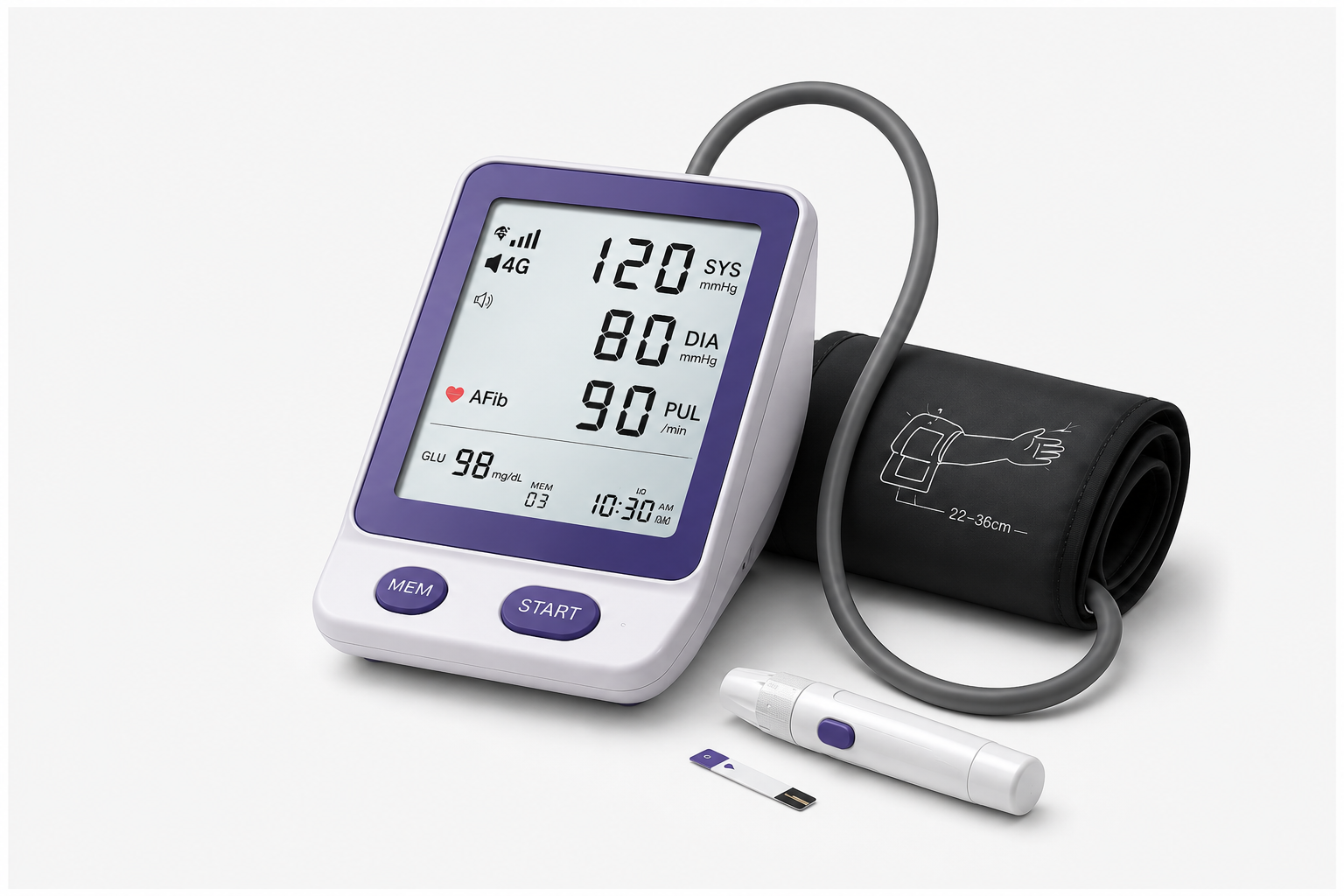
Catch Deterioration Early
Rising blood pressure, weight gain in heart failure or glucose drift shows up in days, not at the next appointment.



Out-of-range readings are triaged against the thresholds you set, so your team focuses on the patients who need attention and routine readings are handled.
Weeks of home readings show you what is really happening, so you can act sooner and with more confidence.
The difficulty has never been the data. It is finding the time to review it, contact the patient and document the work.
Rising blood pressure, weight gain in heart failure or glucose drift shows up in days, not at the next appointment.

See the effect of a medication change within days and adjust between visits.

Your thresholds decide what reaches you. Routine readings are handled.

Walk in with trend summaries, not one number taken in a busy office.

Monthly check-ins and the e-Vitals Go app keep patients on their plan.

Our clinical team handles routine monitoring under your general supervision.
By clinical specialty:
Don't see your specialty? Talk to us about customizing thresholds for yours.

Choose the patients whose condition you want to track more closely between visits.
Order monitoring and set the thresholds that decide what is escalated to you.
Your thresholds decide what reaches your clinicians.

Devices are supplied to your office. We handle patient education and consent documentation.
Daily reading review, monthly check-ins, escalation by your thresholds and time tracking.
Everything around the clinical decision, so the program does not add to your team's workload.

Medicare pays for remote monitoring every month a patient qualifies. For 2026, CMS added codes for shorter monitoring periods and shorter clinical time, so more of the work you already do is now billable.
| CPT Code | What it covers | Time / requirement | Est. reimbursement* |
|---|---|---|---|
| 99453 | Initial setup & patient education | Once per episode of care | ~$19.65 |
| 99454 | Device supply & transmission | 16+ days of readings in 30 days | ~$48.80 / 30 days |
| 99445New 2026 | Device supply & transmission | 2–15 days of readings in 30 days | ~$28.50 / 30 days |
| 99470New 2026 | Treatment management, first 10 minutes | 10–19 minutes of staff time in a month | ~$29.20 / month |
| 99457 | Treatment management, first 20 minutes | 20 minutes with an interactive communication | ~$48.30 / month |
| 99458 | Treatment management, each additional 20 | Each additional 20 minutes after 99457 | ~$38.75 / unit |
| 99091 | Physician data interpretation | 30 minutes of physician or QHP time in 30 days | ~$54.40 / 30 days |
*Reimbursement figures are approximate 2026 Medicare national-average non-facility rates for educational purposes only and are not billing, legal, or financial advice. Rates change annually and vary by payer and locality. Verify against the current Medicare Physician Fee Schedule before billing. CPT® is a registered trademark of the American Medical Association.
$8,196 per month · $94 per billable patient per month
Gross estimate using 2026 Medicare national-average non-facility rates. Patients who do not reach 20 minutes are assumed to reach 10 (99470). Excludes patient coinsurance, payer mix and program costs. Not a guarantee of payment.
Home readings support measures like blood pressure control and diabetes management that drive MIPS scores and shared-savings contracts.
Monthly contact keeps patients connected to your practice and brings them back for follow-up visits when readings call for it.
Monthly codes create steady income that grows with enrollment, independent of how full your visit schedule is.
RPM can be billed in the same month as CCM or PCM without counting time twice.
Everything your practice needs to launch RPM, based on CMS guidance, in a free 2-page PDF: which patients are eligible, the 2026 codes and requirements, how Medicare, Medicaid and commercial plans pay, billing with CCM and PCM, and a documentation checklist.
Physicians and non-physician practitioners eligible to provide evaluation and management services. Auxiliary personnel may provide RPM services under the billing practitioner's general supervision.
No. e-Vitals clinical staff can perform daily review and monthly patient communication on your behalf. Your clinicians step in only when a reading crosses the thresholds you set.
CMS finalized 99445 for months with fewer than 16 days of data and 99470 for months with fewer than 20 minutes of management time. Months that previously fell short of those thresholds can now be billed.
Yes. CMS allows RPM concurrently with chronic care management and principal care management, as long as time is not counted toward more than one service. RPM and remote therapeutic monitoring cannot be billed together.
RPM is a Part B service paid under the Medicare Physician Fee Schedule. Each code is paid separately for each 30-day period the patient qualifies, and amounts are adjusted for your Medicare locality.
Under Original Medicare, the Part B deductible and 20% coinsurance apply to RPM codes. Supplemental or secondary coverage may cover some or all of that share. Patients should know about cost sharing before they consent.
Medicare Advantage plans must cover services that Original Medicare covers, but each plan sets its own payment rates, network rules, prior authorization and cost sharing. Commercial coverage varies by payer and is set by your contract.
It depends on the state. Many state Medicaid programs reimburse for RPM, often limited to certain conditions, provider types and devices. Check your state's rules before enrolling Medicaid patients.
See how e-Vitals helps your practice launch, run and document Medicare care programs with devices, onboarding, clinical dashboards and billing support in one platform.