

Remote Patient Monitoring built for outcomes and reimbursement.
e-Vitals collects, transmits, and displays physiologic data from FDA-cleared devices — giving providers continuous visibility between visits, with the documentation and billing automation to make it sustainable.
Heart rate
72 bpm
Normal
Blood pressure
118 /76
Optimal
Blood glucose
104 mg/dL
In range
Weight
168 lb
Stable
Overview
What is remote patient monitoring?
RPM empowers patients to take control of their health from the comfort of home. Using connected medical devices — like blood pressure cuffs, glucometers, or pulse oximeters — patients capture their vital data daily, which is automatically transmitted to their care team in real time. Clinicians use this continuous stream of data to spot trends, catch warning signs early, and intervene before a condition escalates — all without requiring an in-person visit. For chronic conditions like hypertension, diabetes, and COPD, this means fewer hospitalizations and better long-term outcomes.
Physiologic data RPM can capture includes:
Data flows automatically
A connected, cellular device captures a reading and uploads it straight to your secure dashboard — no Wi-Fi, app, or manual entry.
Requirements
What Medicare requires for RPM
The rules below come straight from current CMS and HHS guidance. e-Vitals is built so your program meets every one.
- Only physicians and qualified practitioners who can bill evaluation & management (E/M) services may bill RPM.
- Remote physiologic monitoring requires an established patient relationship.
- Monitoring must address an acute or chronic condition and be medically reasonable and necessary.
- The device must meet the FDA's definition of a medical device.
- Physiologic data is collected electronically and automatically uploaded to a secure location for the billing practitioner to review.
- Patient consent is required at the time RPM is furnished — auxiliary staff under general supervision may obtain it.
- Auxiliary personnel may furnish RPM under the general supervision of the billing practitioner.
How it works
From enrolling to billing in 4 steps
Enroll eligible patients
We identify and enroll eligible patients and provision the device.
Connect device
Cellular devices sync to patient charts the moment they're switched on.
Monitor & intervene
Your clinical team reviews data, documents time, and escalates when needed.
Bill & reconcile
A monthly, audit-ready RPM & CCM codes report is generated.
Platform
Core platform features
Real-time data dashboard
Vitals — BP, heart rate, glucose, and weight — in one intuitive interface.
Automatic device sync
Cellular devices post readings straight to the chart with no patient setup.
Smart alerts & triage
Thresholds learn each patient's baseline and escalate only what matters.
EHR integration
Bi-directional sync with major EHR systems.
Audit-ready billing
Device-days and time logged for CPT 99453, 99454, 99457, 99458, and 99091 — audit-ready.
Population health
Segment patients by condition, risk, and adherence.
Devices
FDA-cleared monitoring devices
Cellular, ready out of the box — no Wi-Fi, pairing, or apps for patients.
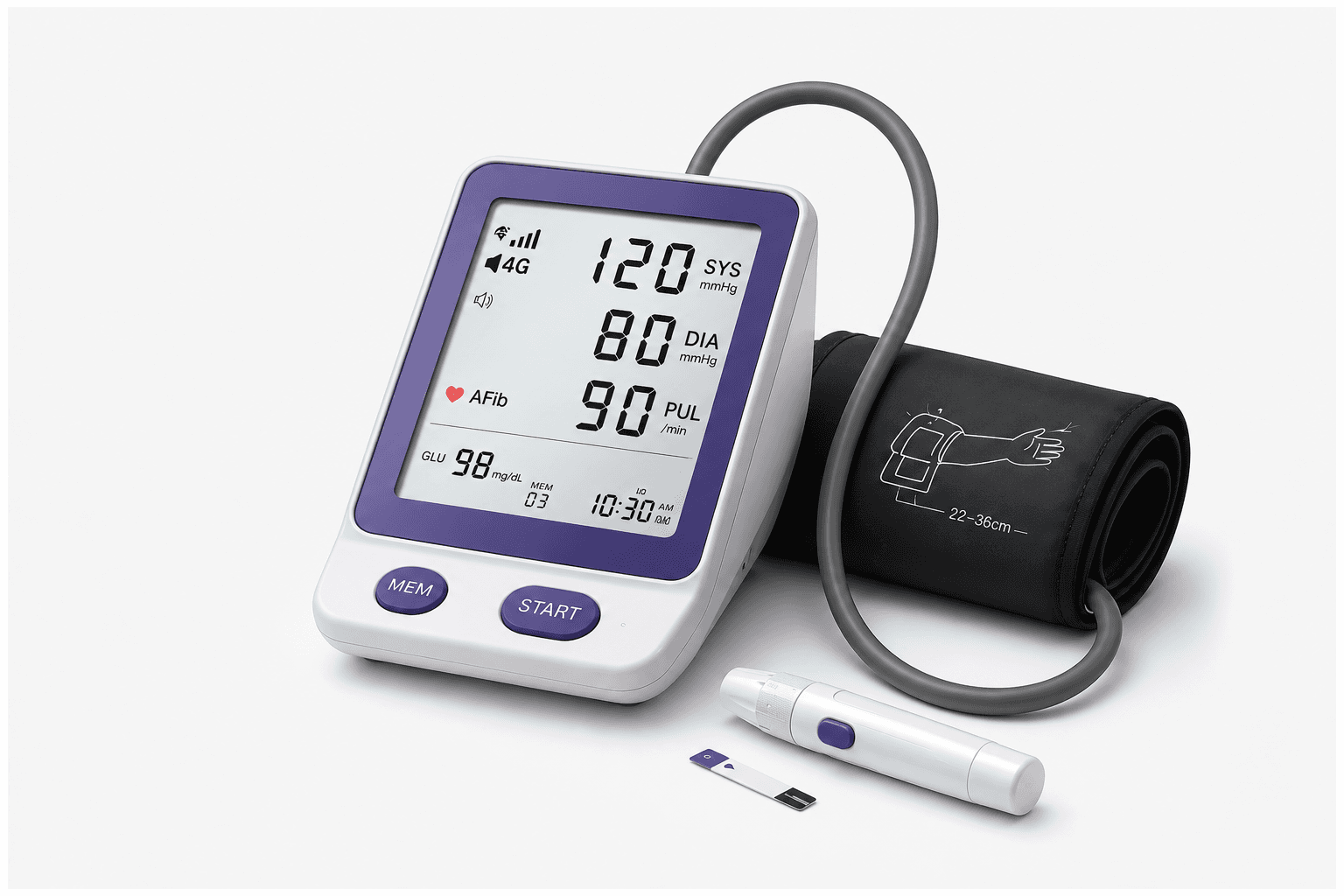
2-in-1 Blood Pressure & Glucose Monitor
- Audible results in English & Spanish
- Atrial Fibrillation detection (AFib)
- Automatic BP averaging per AHA/ACC
- Built-in 4G cellular SIM
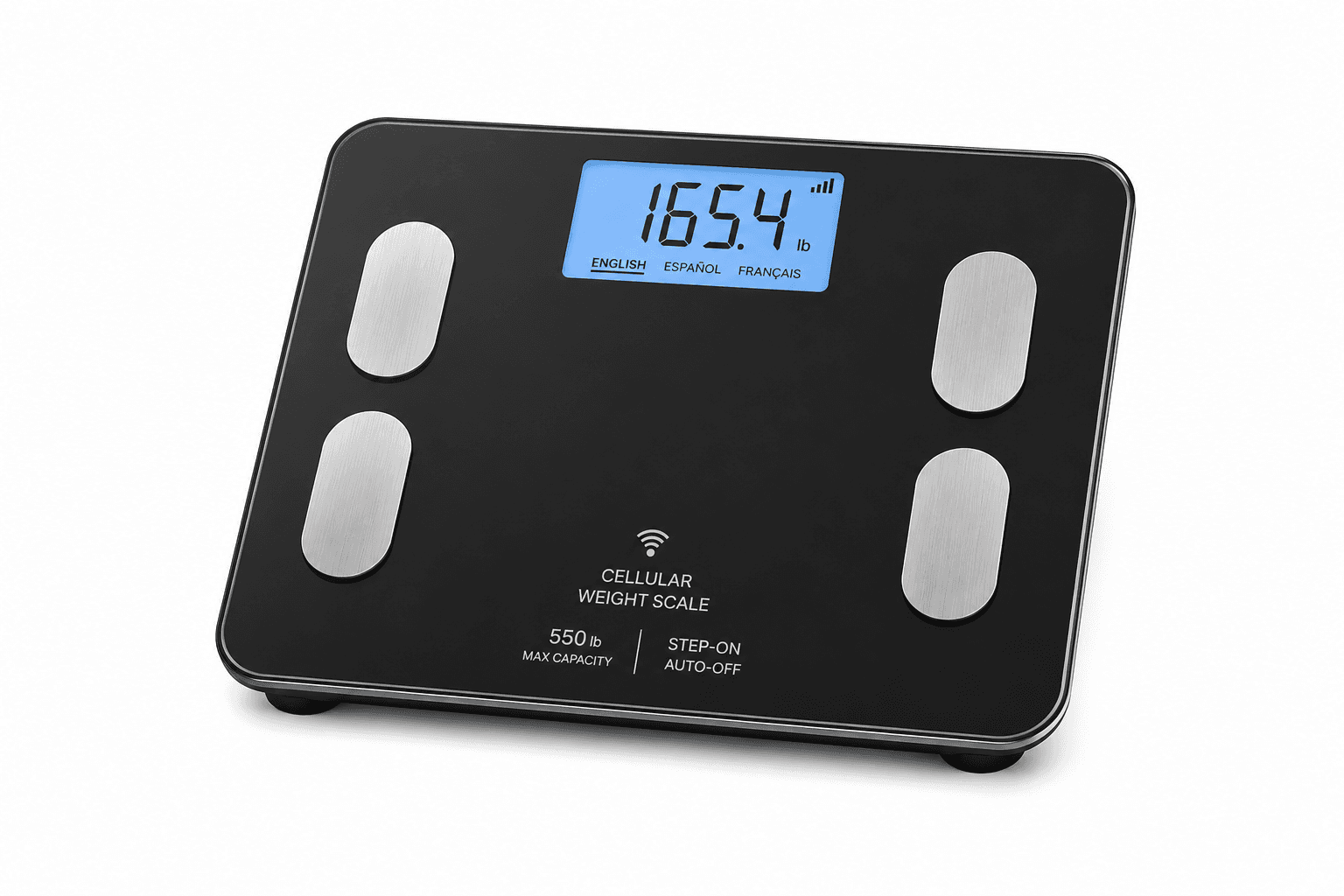
Cellular Weight Scale
- Supports up to 550 lbs
- Large backlit, high-contrast LCD
- Results in English, Spanish & French
- Automatic step-on, auto-off
Reimbursement
How RPM is billed
RPM has three components that build on each other — each with its own CPT codes.
| CPT | What it covers | Frequency | Approx. avg* |
|---|---|---|---|
| 99453 | Setup & patient education Initial setup and education on the monitoring device(s). | Once per episode | $20 |
| 99454 | Device supply + data (16+ days) Device supply with daily recordings; requires ≥16 days of readings. | Each 30 days | $45–50 |
| 99445New 2026 | Device supply + data (2–15 days) Device supply when only 2–15 days of readings are collected. | Each 30 days | varies |
| 99470New 2026 | First 10 minutes of management Management with interactive communication; 10–19 total minutes. | Monthly | $10–26 |
| 99457 | First 20 minutes of management Treatment management requiring interactive communication. | Monthly | $48–52 |
| 99458Add-on | Each additional 20 minutes Add-on to 99457 for each additional 20 minutes. | Monthly (add-on) | $41 |
| 99091 | Physician data interpretation Collection & interpretation of physiologic data by a physician/QHP. | Each 30 days | $50–56 |
Want to see what RPM could mean for your panel? Model patients, codes, and rates in the live calculator.
Estimate revenueApproximate national averages; actual payment varies by payer, locality, and program mix. Not billing advice — verify against the current Medicare Physician Fee Schedule. CPT© is a registered trademark of the AMA.
Concurrent billing
What RPM can run alongside
RPM pairs with most care-management programs. e-Vitals keeps time per program distinct so claims hold up.
Can run alongside RPM
- Chronic care management (CCM) — bill RPM and CCM together for an eligible patient when the time counted toward each is distinct.
- Transitional care management (TCM), behavioral health integration (BHI), principal care management (PCM), and chronic pain management (CPM) — RPM may run concurrently with each, without double-counting time.
- During a global surgery period — a practitioner not receiving the global payment may bill RPM for an unrelated underlying condition.
Can't be billed together
- More than one practitioner billing RPM for the same patient in a 30-day period.
- Any time already counted toward another billed service — RPM minutes can't be counted twice.
The combined opportunity
Run RPM and CCM together — compliantly.
For an eligible patient, RPM and chronic care management can both be billed in the same month when the time counted toward each is distinct. e-Vitals tracks both programs in one dashboard.
Explore CCMFAQ